construction worker using a jackhammer while wearing NRR 27 ear plugs

NRR Ratings Explained: What the Numbers on Your Ear Plugs Actually Mean

Every pair of ear plugs, earmuffs, or hearing protection device sold in the United States has a number on the package: the NRR. You have probably seen it. NRR 22. NRR 27. NRR 33. But what does that number actually tell you? Let’s get into NRR Ratings Explained.

How much protection am I actually getting? The short answer: less than you think. The NRR is not a straightforward “this blocks X decibels of noise” number, and misunderstanding it is one of the most common mistakes workers make when choosing hearing protection.

This guide breaks down what the NRR means, how to use it to estimate your real-world noise exposure, how it compares to the SNR system used outside the United States, and how to pick the right rating for your job.

What Does NRR Stand For?

NRR stands for Noise Reduction Rating. It is a single number, measured in decibels (dB), that indicates how much a hearing protection device reduces noise under ideal laboratory conditions.

The key phrase there is “ideal laboratory conditions.” The NRR is determined through standardized testing (ANSI S3.19 or the newer ANSI S12.6) where the device is fitted perfectly on test subjects in a controlled acoustic environment. On a real job site, with sweat, movement, imperfect fit, and hair in the way, the actual noise reduction is lower.

That gap between the lab rating and real-world performance is something every worker should understand.

How to Calculate Real-World Noise Reduction

OSHA and NIOSH use different methods to estimate how much protection you actually get from a given NRR. Here is the most common calculation, which OSHA uses:

Step 1: Take the NRR number on the packaging.

Step 2: Subtract 7.

Step 3: Divide the result by 2.

That gives you the estimated real-world noise reduction in decibels.

Example with NRR 27 ear plugs (like PermaPlug):

(27 – 7) / 2 = 10 dB of estimated real-world reduction

So if you are working in a 95 dB environment with NRR 27 ear plugs, your estimated exposure drops to about 85 dB, which is right at the OSHA action level.

This might seem like a big gap from the advertised 27 dB, but it reflects the reality that most people do not achieve a perfect seal every time they insert ear plugs. Proper fit technique makes a significant difference, which is why learning to insert your ear plugs correctly matters almost as much as choosing the right NRR.

NIOSH uses an even more conservative estimate for ear plugs specifically: they recommend derating the NRR by 50% (multiply by 0.5) instead of using the OSHA formula. Under the NIOSH method, NRR 27 ear plugs would give you an estimated 13.5 dB of real-world reduction. The NIOSH approach builds in a larger safety margin, which is especially relevant for workers who are exposed to noise for full 8-hour shifts.

How Loud Is Your Job? Common Noise Levels

To know if your hearing protection is adequate, you need to know how loud your work environment is. Here are typical decibel levels for common tools and situations:

Under 85 dB (generally safe without protection):

  • Normal conversation: 60-70 dB
  • Vacuum cleaner: 70-75 dB
  • City traffic from inside a car: 80-85 dB

85-100 dB (hearing protection recommended or required):

  • Hand drill: 85-90 dB
  • Lawn mower: 85-90 dB
  • Shop vacuum: 85-90 dB
  • Belt sander: 90-95 dB
  • Circular saw: 90-100 dB
  • Tractor: 90-95 dB

100-115 dB (hearing protection required):

  • Table saw: 100-105 dB
  • Chainsaw: 105-115 dB
  • Jackhammer: 100-110 dB
  • Impact wrench: 100-110 dB
  • Nail gun: 100-110 dB
  • Angle grinder: 100-110 dB

Over 115 dB (hearing protection critical):

  • Hammer drill on concrete: 110-120 dB
  • Ambulance siren at close range: 120 dB
  • Gunshot: 140-170 dB

OSHA requires employers to provide hearing protection and implement a hearing conservation program when worker noise exposure reaches 85 dB averaged over an 8-hour shift. At 90 dB, engineering or administrative controls are required in addition to hearing protection.

What NRR Do You Need?

Your goal is to get your effective noise exposure below 85 dB. Here is how different NRR ratings perform across common noise levels, using the OSHA derating formula:

NRR 22 (estimated real-world reduction: 7.5 dB)

  • 90 dB environment → ~82.5 dB (adequate)
  • 100 dB environment → ~92.5 dB (not adequate)
  • Best for: light-duty tasks, lawn mowing, shop work under 95 dB

NRR 27 (estimated real-world reduction: 10 dB)

  • 95 dB environment → ~85 dB (adequate)
  • 100 dB environment → ~90 dB (marginal; okay for shorter exposure)
  • 110 dB environment → ~100 dB (not adequate alone)
  • Best for: general construction, power tools, manufacturing, most job sites

NRR 33 (estimated real-world reduction: 13 dB)

  • 100 dB environment → ~87 dB (adequate)
  • 110 dB environment → ~97 dB (marginal)
  • Best for: heavy equipment, chainsaws, extended high-noise exposure

For extremely loud environments over 105 dB, consider doubling up: wearing ear plugs under earmuffs. When you combine two devices, you do not add their NRR numbers together. Instead, take the higher NRR and add 5 dB. So NRR 27 plugs under NRR 25 earmuffs gives you an effective NRR of about 32, which translates to roughly 12.5 dB of estimated real-world reduction using the OSHA formula.

NRR vs. SNR: What Is the Difference?

If you buy hearing protection made in Europe or see products with international certifications, you may notice an SNR rating instead of (or alongside) the NRR. They measure the same thing, noise reduction capability, but they use different testing standards and different math.

NRR (Noise Reduction Rating): Used in the United States. Tested per ANSI S3.19 or ANSI S12.6. Measured in C-weighted decibels and subtracted from C-weighted noise measurements (or derated and subtracted from A-weighted measurements using the formulas above).

SNR (Single Number Rating): Used in Europe and internationally. Tested per EN 352/ISO 4869-2. Generally produces a higher number than NRR for the same device because of differences in the testing method and calculation.

A product rated NRR 27 might carry an SNR of 34. Those are not contradictory; they just reflect different measurement standards. You cannot directly compare NRR and SNR numbers or use the OSHA derating formula on an SNR value.

When in doubt, use the NRR number for any calculations related to OSHA compliance in the United States.

Why a Higher NRR Is Not Always Better

It might seem logical to always grab the highest NRR available, but overprotection can create its own problems:

  • Communication: If you cannot hear coworkers, warning signals, or equipment alarms, that is a safety hazard. Workers who feel isolated by their hearing protection are more likely to remove it or wear it improperly.
  • Comfort: Higher NRR devices often achieve their rating through a tighter seal or denser material, which can mean more ear canal pressure and discomfort over long shifts.
  • Compliance: The most protective ear plug in the world does nothing if your crew takes them out after 20 minutes because they are uncomfortable. The best hearing protection is the one people actually wear.

The ideal NRR brings your exposure below 85 dB without cutting you off from your environment. For most construction and manufacturing settings, NRR 25-30 hits that sweet spot.

What About Fit?

The NRR assumes proper insertion. With ear plugs, “proper insertion” means the plug is deep enough in the ear canal to create a complete seal. Most people do not insert ear plugs deeply enough, which is the single biggest reason real-world protection falls short of the lab rating.

Signs your ear plugs are not inserted correctly:

  • You can still hear conversations clearly at normal volume
  • The plug feels like it is sitting in the opening of your ear rather than inside the canal
  • The plug slides out or loosens on its own during work

Triple-flange designs (like PermaPlug ear plugs) have an advantage here: the graduated flanges create a seal at multiple points in the ear canal, so even if insertion is not perfect, you still get meaningful protection. This is one reason flanged plugs tend to perform closer to their rated NRR in real-world use compared to foam plugs that require precise rolling and insertion technique.

Frequently Asked Questions

Is a higher NRR always safer?

Not necessarily. You need enough protection to bring your exposure below 85 dB, but too much can prevent you from hearing important sounds like alarms, equipment warnings, or coworker communication. Match the NRR to your noise environment.

Do I add the NRR numbers together if I wear plugs and earmuffs?

No. Take the higher NRR of the two devices and add 5 dB. That is your combined effective NRR.

How often should I replace my ear plugs?

Disposable foam plugs are single-use. Reusable silicone or TPR plugs (like PermaPlug) last weeks to months with regular cleaning. Replace them when the material loses its flexibility or no longer creates a snug seal.

Can I use the same ear plugs for shooting and construction?

Yes, as long as the NRR is adequate for both environments. Gunshots produce 140-170 dB, which is extreme. NRR 27-33 ear plugs will help, but serious shooters often double up with plugs plus earmuffs.

What is the minimum NRR required by OSHA?

OSHA does not specify a minimum NRR. Instead, OSHA requires that the hearing protection you provide reduces worker exposure below 90 dB (or 85 dB for workers already in a hearing conservation program). The NRR you need depends on the noise level of your specific work environment.

What does “NRR 27 dB” mean in practical terms?

Under laboratory conditions, the device reduces noise by 27 decibels. In real-world use, OSHA estimates the actual reduction at about 10 dB using their derating formula. With proper fit technique, your actual protection will fall somewhere between those two numbers.

Read More
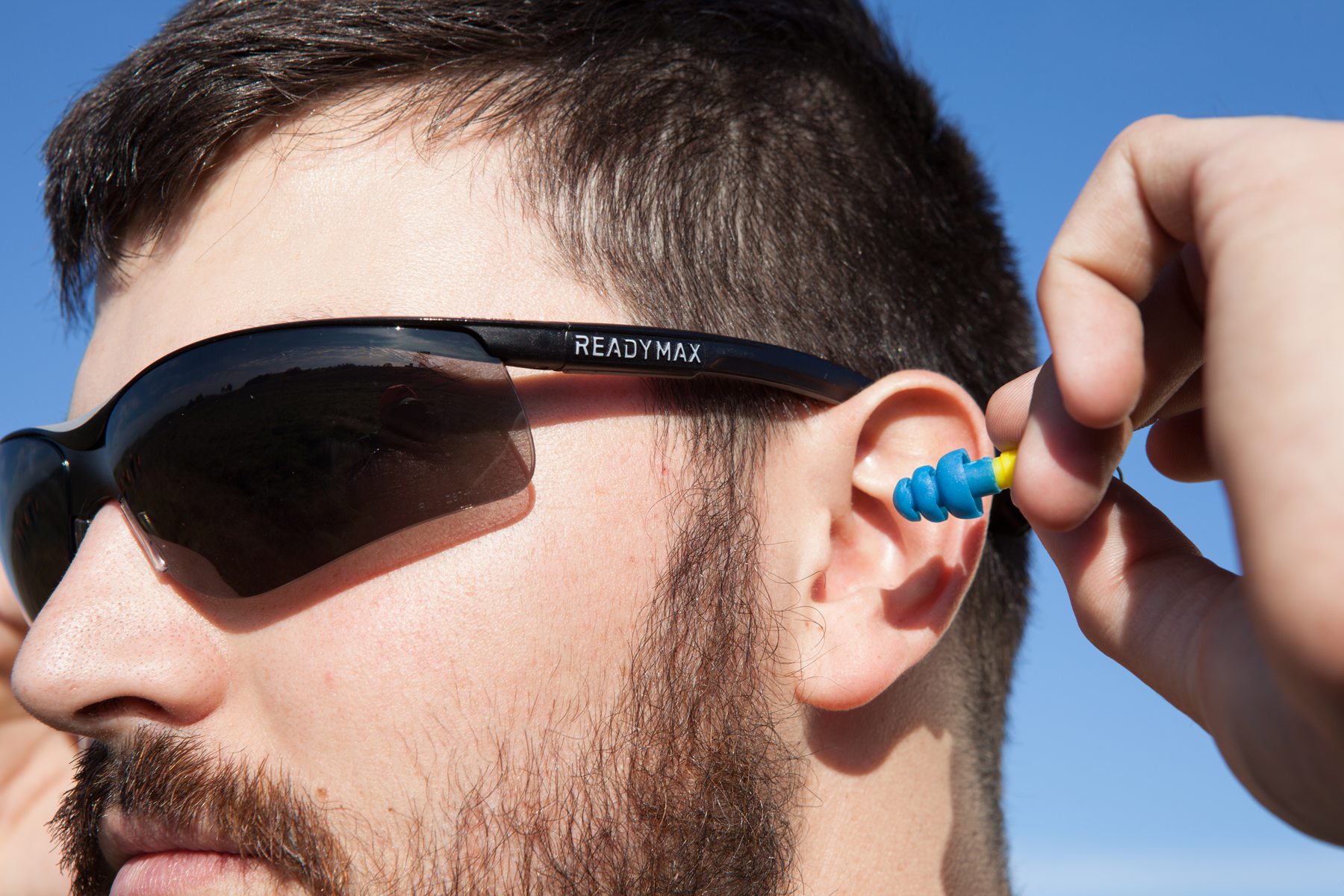
A worker wearing SoundShield safety glasses inserting the earplugs into his ear

Why I Built Safety Glasses with Built-in Ear Plugs

Jim Duffy is the founder of ReadyMax and the inventor of the SoundShield integrated hearing protection system. He holds multiple international patents for retractable tethered hearing protection technology.

ReadyMax started because the safety industry ignored human nature. Workers skip hearing protection because friction kills compliance. Foam plugs get lost, collect grit in pockets or sit on workbenches while the circular saw is running. By the time a worker realizes they need protection, the hardware is missing. They keep working. They sacrifice their hearing for the sake of the schedule.

I founded ReadyMax to eliminate that gap. The goal was to build safety glasses with built-in ear plugs. Tie hearing protection to the one piece of gear that stays on the face. If the protection is already there, the worker uses it.

The SoundShield Mechanism

The logic of SoundShield is mechanical. We built retractable ear plugs directly into the temple pieces of the frames. When the decibels spike, you pull them out. When the task is done, a slide mechanism retracts the plugs back into the housing. A flip closure caps the ends. This keeps the silicone clean, dry and isolated from the job site environment.

a man wearing soundshield safety glasses with retractable earplugs inserting the ear plugs into his ears.

There is no separate carrying case to lose. There is no fumbling through pockets with gloved hands. The hearing protection is tethered to the glasses. It stays within reach at all times.

Independent Validation

We ran an independent research study through a firm in San Francisco to test this hardware against standard industry gear. We needed to know if the convenience translated to actual preference.

The data was conclusive. 19 out of 20 regular safety product users preferred SoundShield over their existing equipment. That 95% preference rate confirms that workers prioritize availability. They do not want more complex ear plugs. They want plugs that are present when the noise starts.

Recognition and Field Results

The design earned Innovation of the Month from Popular Mechanics. The Retail Dealers Trade Association also named SoundShield the best new product at the National Hardware Show.

While industry awards validate the engineering, the true metric is daily uptime on the job site.

The ReadyMax Ecosystem

One successful design proved the core thesis. We expanded the tethered concept to cover the entire safety equipment stack:

  • RipCord Retractors attach retractable plugs onto hard hats and bump caps
  • ZipOuts integrate protection into hardhats via 3M Adhesive and a zipper mechanism
  • PlugsPockets add dedicated tethered storage to standard safety vests

All these units use PermaPlug ear plugs. These plugs carry an NRR 27 decibel rating. They are washable, reusable and biodegradable. One pair of PermaPlugs replaces stacks of disposable foam. This reduces the footprint of the operation and cuts down on waste.

The Economics of Waste

Disposable foam plugs are a hidden drain on overhead. A safety team at a major manufacturing plant audited their consumption and found workers used multiple pairs per day. For a workforce of thousands, the cost is massive.

Their audit showed that switching 50% of the staff to SoundShield would save millions of dollars annually. This does not even account for the reduction in Foreign Object Debris (FOD). Foam plugs on the floor are a liability in food processing and precision manufacturing. Tethered plugs stay off the ground and out of the machinery.

Bottom Line

ReadyMax exists because convenience is the only way to guarantee safety. I spent twenty-five years hearing workers say they finally wear their protection because it is right there on their frames. That is the only metric that matters. The safest gear is the gear that is actually being worn when the machines turn on.

Check the technical specs for SoundShield and the ReadyMax line to see the hardware in action.

Read More

The Definitive Guide to Retractable Hearing Protection

If you have ever left your ear plugs in the truck, fished around in your pockets for a pair that ended up covered in sawdust, or just gone without hearing protection because it was not worth the hassle, ReadyMax built its entire product line around solving that problem.

Every ReadyMax product uses the same core idea: attach hearing protection directly to the safety gear you are already wearing, so it is always within reach when noise levels spike. No searching, no forgetting, no excuses.

But ReadyMax makes five different products, and they are not interchangeable. Each one is designed for a specific type of gear and a specific work situation. This guide breaks down what each product does, how it works, and which one makes sense for you.

The Quick Comparison

Before we get into the details, here is the overview:

SoundShield Safety Glasses – Safety glasses with built-in retractable ear plugs stored in the temples. Best for anyone who needs both eye and ear protection and does not wear a hard hat.

RipCord Retractors – Compact retractable ear plugs that peel-and-stick to hard hats or safety vests. Push-button retraction, 15-inch tether. Best for hard hat workers who want a low-profile setup.

PlugsPockets – Retractable ear plugs housed inside reflective protective pockets. Peel-and-stick to safety vests or hard hats. 15-inch tether. Best for vest-wearing workers who want their plugs protected from dust and debris.

Zip-Outs – The most compact option. A thin adhesive strip that mounts inside your hard hat with ear plugs that zip in and out of a vinyl cover. Best for workers who want hearing protection that adds zero bulk to their helmet.

PermaPlug Ear Plugs – The reusable silicone ear plugs used across every ReadyMax product. Sold separately as replacements.

All ReadyMax hearing protection products are rated NRR 27 dB (SNR 34). They all use the same PermaPlug ear plugs, and those plugs are washable, reusable, and replaceable across every product in the lineup.

SoundShield Safety Glasses: Eye and Ear Protection in One

ReadyMax SoundShield Classic Safety Glasses with built-in retractable ear plugs

Attaches to: Nothing; they are the gear

Best for: Construction, woodworking, shooting, lawn care, manufacturing, DIY projects

SoundShield glasses are the flagship ReadyMax product and the only option that combines eye protection with hearing protection in a single piece of equipment. The ear plugs retract into the temples of the glasses when you do not need them. When noise picks up, pull them out, insert them, and keep working. When things quiet down, they retract back into the frame.

The lenses are polycarbonate, anti-fog, and scratch resistant. They block 99% of UVA and UVB rays and carry ANSI Z87.1-2020, CSA Z94.3-07, and CE impact certifications, which means they meet or exceed the safety standards required on most job sites in the United States, Canada, and Europe.

The ear plugs are tethered to the glasses with a 22 lb. test nylon cord. If an ear plug comes loose while you are working, it stays attached to the frame instead of falling onto a dirty shop floor or disappearing into the grass.

SoundShield Styles

ReadyMax offers several SoundShield models to fit different face shapes, work environments, and needs:

  • Classic: Wrap-around half-frame design with extensive side shield protection. Available in clear and grey lenses. The most popular model and the best all-around choice for construction and outdoor work.
  • Pro Series 1: Full-frame design for maximum coverage. Compatible with an optional EVA foam gasket for a sealed fit that blocks dust and fine particles. Best for dusty or debris-heavy environments.
  • Fit Over: Designed to fit over prescription eyeglasses. If you wear corrective lenses and need safety-rated eye and ear protection, this is the only option that does not require prescription safety lenses.
  • Men’s Sport and Women’s Sport: Streamlined styling for recreational use. Good for shooting ranges, yard work, and outdoor activities where you want protection without looking like you just walked off a job site.
  • Bi-Focal 2.0: Pro Series frame with a +2.0 magnification zone in the lower portion of the lens. For workers who need reading magnification to see gauges, labels, or small parts up close.

Who Should Choose SoundShield

Pick SoundShield if you need both eye and hearing protection and you do not wear a hard hat. They are the simplest solution: one piece of gear covers two OSHA requirements. They are also the best choice for recreational use (shooting, woodworking, lawn care) because they do not require any other equipment to function.

If you already wear a hard hat with a face shield, SoundShield may not be the best fit since you already have eye protection covered. In that case, look at the hard hat options below.

RipCord Retractors: Retractable Ear Plugs for Hard Hats and Vests

ReadyMax RipCord Retractors with retractable ear plugs for hard hats

Attaches to: Hard hats, bump caps, safety vests

Best for: Construction, manufacturing, forestry, any job where you wear a hard hat

RipCord Retractors are compact, spring-loaded retractable ear plug units that mount to your hard hat or safety vest with 3M peel-and-stick adhesive and Velcro. Each retractor spools out up to 15 inches of tether, which is enough slack to comfortably reach your ears and move your head freely. A push-button mechanism locks the cord when the plugs are extended, and the spring retracts them when you are done.

The key difference between RipCord Retractors and PlugsPockets is that RipCord Retractors do not have protective pockets. This makes them more compact and lower-profile, which is an advantage when mounting on hard hats where space is limited. The retractors sit flat against the surface and do not interfere with other gear.

Who Should Choose RipCord Retractors

Pick RipCord Retractors if you wear a hard hat and want the most compact retractable option. They are slightly better suited for hard hat mounting than PlugsPockets because of their smaller profile. If keeping your helmet setup streamlined matters to you, these are the way to go.

PlugsPockets: Retractable Ear Plugs with Protective Pockets

ReadyMax PlugsPockets retractable ear plugs with reflective protective pockets

Attaches to: Safety vests, hard hats, bump caps

Best for: Road work, construction, utility work, demolition, any vest-wearing job

PlugsPockets are essentially RipCord Retractors housed inside reflective protective pockets. They use the same push-button retractor mechanism with a 15-inch tether, the same 3M adhesive mounting, and the same PermaPlug ear plugs. The difference is the pocket itself: a durable reflective cover that protects the retractor and ear plugs from dust, debris, and moisture when not in use.

The reflective material is designed to match the reflective strips already on your safety vest, so they blend in with your existing gear. This matters in work environments where vest compliance is strict and anything that looks non-standard gets questioned.

Who Should Choose PlugsPockets

Pick PlugsPockets if you primarily wear a safety vest on the job and work in dusty or dirty conditions. The protective pocket keeps the ear plugs cleaner between uses, which matters when you are working around concrete dust, wood shavings, or road debris. They are also the better choice if visibility is a concern, since the reflective pocket material adds to your vest’s reflective coverage.

Zip-Outs: The Most Compact Hard Hat Option

ReadyMax Zip-Outs ear plugs installed inside a hard hat

Attaches to: Inside of hard hats and bump caps

Best for: Utility work, mining, any hard hat environment where you want zero external bulk

Zip-Outs take a different approach from the retractor products. Instead of mounting on the outside of your hard hat, they install on the inside. A thin adhesive strip sticks to the interior of your helmet so that the tethered ear plugs just barely protrude from the back. When you need them, unzip the vinyl cover, pull them out, and insert. When you are done, zip them back into the cover.

Zip-Outs are the smallest and lightest option in the ReadyMax lineup. They add almost no bulk to your helmet and do not interfere with face shields, earmuffs, headlamps, or any other equipment mounted on the outside of your hard hat.

The tether uses a 22 lb. test nylon retractable cord (the same as SoundShield glasses) with a long-life nylon zipper. The entire unit is dielectric (non-conductive), making it safe for electrical work.

Who Should Choose Zip-Outs

Pick Zip-Outs if you want hearing protection that is completely hidden inside your hard hat. They are the best choice when you need your helmet exterior free for other attachments, or when you just want the simplest, most compact option. They are also the most affordable ReadyMax product .

The trade-off: Zip-Outs do not have a spring-loaded retraction mechanism like RipCord Retractors or PlugsPockets. You manually zip the plugs back into the cover. It is a few extra seconds compared to the push-button retraction of the other products.

PermaPlug Ear Plugs: The Universal Replacement

ReadyMax PermaPlug reusable replacement ear plugs

Fits: All ReadyMax products

Every ReadyMax product ships with PermaPlug ear plugs pre-installed, but they do wear out over time. PermaPlug replacement ear plugs are a direct swap across the entire lineup: SoundShield glasses, RipCord Retractors, PlugsPockets, and Zip-Outs all use the same plug.

The plugs themselves are a two-piece co-molded design. The outer layer is soft TPR (thermoplastic rubber) for a comfortable seal, while the stiffer inner core makes insertion easy and consistent. The triple-flange shape fits a range of ear canal sizes without the rolling-and-squeezing routine that foam plugs require.

They are washable with soap and water, reusable for weeks or months depending on how often you use them, and recyclable when they finally wear out. When it is time to replace them, they twist off and on with a simple screw-post connection.

Head-to-Head: How to Decide

Here is a decision framework based on what gear you wear and where you work:

“I do not wear a hard hat.”

Go with SoundShield safety glasses. Pick the Classic for general use, Fit Over if you wear prescription glasses, or Pro Series 1 if you work in dusty conditions and want the gasket option.

“I wear a hard hat and want retractable ear plugs.”

Choose between RipCord Retractors (more compact, no pocket) or PlugsPockets (protective pocket, reflective material). If your job is dusty or dirty, go with PlugsPockets. If you want the lowest-profile hard hat setup, go with RipCord.

“I wear a hard hat and want the simplest, most affordable option.”

Go with Zip-Outs. They install inside the helmet, and stay completely out of the way.

“I wear a safety vest but not always a hard hat.”

PlugsPockets are designed for this. They mount directly to your vest with 3M adhesive.

“I already have ReadyMax gear and need fresh ear plugs.”

PermaPlug replacement ear plugs. One product fits everything.

What They All Have in Common

Regardless of which product you choose, every ReadyMax hearing protection product shares these features:

  • NRR 27 dB noise reduction (SNR 34 international rating): Enough protection for power tools, heavy equipment, chainsaws, firearms, and most industrial noise.
  • PermaPlug reusable ear plugs: Washable, replaceable, and interchangeable across all products.
  • Tethered design: Ear plugs stay attached to your gear. They cannot fall on the ground, get lost, or end up in a pocket full of screws.
  • 3M adhesive mounting (on hard hat/vest products): Installs in seconds, holds for the life of the equipment.
  • Dielectric construction (on hard hat/vest products): Safe for use around electrical hazards.
  • Patented designs: ReadyMax holds utility patents on these products.

Frequently Asked Questions

How loud is “too loud” for these ear plugs?

NRR 27 dB means these plugs reduce noise by approximately 27 decibels. As a general rule, they bring a 100 dB environment (chainsaw, table saw) down to about 73 dB, which is roughly the volume of a normal conversation. OSHA requires hearing protection when noise exposure exceeds 85 dB over an 8-hour shift. For extremely loud environments above 110 dB, you may need additional protection such as over-ear muffs on top of the plugs.

Can I use PermaPlug ear plugs from one product in another?

Yes. All ReadyMax products use the same PermaPlug ear plug. A replacement set works in your SoundShield glasses, RipCord Retractors, PlugsPockets, and Zip-Outs.

How long do the ear plugs last?

With regular cleaning (soap and water), PermaPlug ear plugs last weeks to months depending on frequency of use and working conditions. Replace them when the flanges lose their softness or no longer create a snug seal.

Are these OSHA compliant?

Yes. All ReadyMax hearing protection is NRR 27 dB rated, which meets OSHA hearing conservation requirements for most workplace noise exposures. SoundShield glasses also meet ANSI Z87.1-2020 for eye protection.

Can I mount RipCord Retractors or PlugsPockets on a hard hat AND a vest?

Yes. Both products use 3M adhesive and can attach to either surface. Some workers use one pair on their hard hat and a separate pair on their vest for redundancy.


Read More

OSHA Rules for Eye and Face Protection Have Been Updated

New OSHA rules for eye and face protection were published in the US Federal Register on March 25, 2016. Affected companies–which include all employers operating in general industry, shipyards, longshoring, marine terminals, and construction–should reference the full text of the Federal Register as well as the updated consensus standard which has been incorporated by reference, ANSI/ISEA Z87.1-2010 – Occupational and Educational Personal Eye and Face Protection Devices.

Changes are summarized in a media release from MSA Safety (Doc. ID: 0300-05-MC, April 2010). Noteworthy excerpts with underlined formatting for emphasis:

  • Users will need to be educated on matching the hazard from which they need protection with the marking on the product.The Z87 ASC also made efforts to harmonize with other eye and face protection standards used around the world. Many of the tables in this standard reflect this effort to harmonize with global standards.
  • Extended side protection. Spectacles with thin temples (metal frame or thin plastic) will require side shields if they do not pass the extended side coverage requirements.
  • In Z87.1-2003 protective products are marked as providing “Basic” or “High Impact” protection. In the Z87.1-2010 standard, the products are either non-impact or impact protectors. Products marked as impact protectors must pass all high-impact testing requirements and will be marked as Z87+. Non-impact protectors are those which do not pass all high-impact testing requirements and are therefore marked only with “Z87” (no “+” sign).
  • In the Z87.1-2003 standard, protective products are defined as primary and secondary protectors; primary eye protection should be used under secondary protection (i.e., safety glasses must be worn under visors). This is changing in the Z87.1-2010 standard.

Manufacturers adhering to ANSI/ISEA Z87.1 will be keeping pace with new testing and marking specifications. That said, it takes time to deplete existing inventory, test, adapt, manufacture and distribute new models. Changes are gradual and that is precisely why OSHA is adopting the 2010 standard now, in 2016.

Companies can continue to distribute and use PPE determined by hazard assessment to adequately protect against site and task-specific hazards – even if it is marked according to the specifications of previous 1989 and 2003 versions of the ANSI standard.

As the useful service life of existing PPE requires replacement, companies should ask distributors to provide eye and face protection that bears the newly required markings. But first companies need to reassess and revise eye and face PPE recommendations with increased type, use, shade and filter specificity in mind.

OSHA “direct final rule” cadence incorporating industry requirements from prior years suggests future changes as the consensus evolves. Companies would do well now to consider the newer 2015 version of ANSI/ISEA Z87.1 while referencing the recently incorporated 2010 version.

Read More